
Following are most of the political articles I’ve written over the years. And below that extensive list are summaries of each article. Each summary includes a link to the original article.
Original articles from NobleSavageWorld:
- Introduction —— Privatization and the public good —— Military —— Information —— Spirit of Society —— Education —— Regulation —— Economics —— Managing the World in the 21st Century —— The carnal line between noble and savage —— Embrace the divine; it’s where we shine —— Who decides what? —— Finally… good politics
Political articles from MacyAfterlife:
Freedoms on earth and in spirit are worlds apart —— What are morals, ethics, and laws? —— Managing life (part 2) —— Why all the divisiveness? —— Free will vs fate —— Government, society’s “alpha”
More originals from NobleSavageWorld:
Election fraud 2012 —— Humor in politics —— Blown to bits in the computer age —— Standards, the key to peace —— Final thoughts before election 2024
.
Some Original Articles from NobleSavageWorld
1 Introduction
Government and political systems are like the brain and mind of society. They play a huge role in determining to what degree society enjoys peace and prosperity on one hand… or crime, war, and civil unrest on the other. A lot depends on government decision-making, but it’s such a challenge on Earth!… until we add spirituality to the mix. Then it gets easier.
.
2 Privatization and the public good
We’re noble-savage creatures—brilliant souls navigating in rugged carnal bodies—trying to get by in a rough world in which life kills life to survive—so politics gets messy here on Earth. We don’t always have a clear idea about whether government is a good thing or a bad thing… a facilitator of public safety and stability, or an obstruction to human affairs.
Public service is the political term or concept most closely related to our noble side—our spiritual side. It involves government efforts to help people thrive and to minimize human suffering… for example, health, education, and welfare programs.
Private enterprise is the political term most closely related to our savage side. It defines an environment in which individuals and self-motivated groups compete among themselves with minimal government involvement or interference.
Why do we get so emotional about these two concepts?
Well, again, it’s our noble-savage nature.
.
3 Military

It’s mostly our noble-savage nature that keeps stirring up this endless debate over what’s more important—the rights of individuals to be free or the rights of societies to be kept stable and equable by an effective government.
Most people would probably agree: If there’s going to be a military, it should be managed by government. Private interests in charge of military forces would be tempted to run society in their own best interests (especially in market economies, where self-motivation is the way of doing business), neglecting society at large… creating a fascist state.
So… how much of a nation’s government budget should be used for military spending?
Well, once again, if this were a noble world run by trust and good will, there would be no need for a military. Nations, by nature, would get along, share and cooperate.
If it were strictly a savage world without rules, rife with competition—a world of fear and mistrust—then every country’s survival would depend on a strong military. Weak nations would be defeated and absorbed by strong nations.
.
4 Information
Even as a kid in school I was fascinated by the nested structure of things… systems within systems within systems—body cells within tissues within people within families within communities within countries within humanity….
In high school and beyond, one of my main interests was the similarity between the inner workings of the human body and the inner workings of human society. I spent years thinking, researching and writing about how societies behaved like big, lumbering people… and how people did for their societies what body cells do for the body. I saw a lot of similarities and also a lot of differences… and I tried to understand exactly what it was that made human beings different from body cells….

The brain is the body’s computer complex. It processes information and serves it to all parts of the body. Most of the decisions throughout the body are still made at the cellular level, via DNA, energy production in the mitochondria, and other activity within and among cells… but the high-level decisions that affect the entire body are executed largely by the brain.
Government at the national level (what we in the States call “federal government”) is the brain of society, processing high-level information and serving it to the system in the form of laws, rules, and regulation.
National politics is the mind of society. Decisions are made by political bodies within government (legislatures, councils, judicial systems…) that try to take into account the well-being of the rest of society.
Government is the hardware for social regulation; politics is the software. Politics, in its purest form, would be the spirit of society.
Politics today has not yet evolved into its purest form and is not really the spirit of society….
.
5 Spirit of society
The previous article compared society, populated by millions of collaborative human beings depending on each others’ skills, to a human body populated by trillions of synergistic body cells. The trouble is… Humans aren’t body cells. For one thing, people need personal freedom, whereas body cells seem to be relatively selfless.
Still, the comparison can tell us a lot about the benefits and drawbacks of political systems like capitalism/free enterprise, socialism/communism, and religion-based governments. Those benefits and drawbacks are examined in the original article.
.
6 Education
While our noble human qualities have graced modern society with countless marvels like the Internet, cell phones, iPads, space stations, and lasers, our savage side has been nipping relentlessly at our heels… stirring up lawsuits, theft, international conflicts, and all manner of problems.
Most human suffering down through the ages has been caused by our savage side… far more than what’s caused by natural disasters, diseases, predators, and other forces outside human affairs. For the most part we humans create our own suffering.
For that reason, I’ve long believed that the main role of education should be to strengthen our noble side and to teach us how to contend with our savage qualities, starting at a young age and continuing into adulthood….
.
7 Regulation
Human society is a hodgepodge of energy and activity. Each of us humans (and there are some 8 billion of us alive today) thinks our own thoughts, speaks our own words, and does our own thing. Each of us belongs to groups (family, friendships, clubs, companies…), and every group does its own thing. Most groups belong to bigger groups (communities, associations, industries, nations…) and each of these big groups does its own thing.
Lots going on within and among societies all the time. Things would be total chaos were it not for regulation.
There are probably more ways to define regulation than there are names for it: management, leadership, administration, governance, ordinance, superintendance, guidance, direction….
But if we tossed all those definitions into a pot and boiled them down, we would probably wind up with two basic ingredients of sensible regulation — monitoring activities and making changes when necessary….
.
8 Economics
(This big article is a toned-down version of a patent application I submitted but got denied. It can be found on the USPTO website, searching on the application # 20100094672…)

A new, simpler way to define economics, wrapped up in a simple formula:
V ≡ R : N
Economic vitality (V) is determined by the natural resources (R) available to a social system, in relation to the system’s resource needs (N).
Making the ratio viable requires new, concise definitions of such concepts as products, natural resources, and social systems.
(In a nutshell: 1) Society consists of people and products the way the human body consists of cells and molecules. 2) Society consumes natural resources the way a person consumes food. 3) The vitality of society is determined mainly by “proper diet” of natural resources that need to be available. Problems happen when needs outstrip resources.)
Once that’s all done, the ratio could be programmed into a system-wide computer network, accepting input relating to needs and resources from throughout the system and issuing an alert in the event of a negative ratio.
Monitoring this “vitality ratio” would ensure the economic health of society.
I wouldn’t be surprised to learn that the entire cosmos operates on this simple economic principle, in which vitality (V) is determined mostly by the life-energy needs (N) of any spirit, extraterrestrial, world, or universe, in relation to the amount of life-energy it receives (R) from the eternal source that rests at the center of everything.
.
9 Managing the World in the 21st Century
How best to manage the world? That’s the big question.
The right answer will be a lot different today than it was a thousand years ago… or even 50 years ago. It’s a different world, thanks to modern realities like burgeoning population (8 billion mouths to feed), energy use (especially the exhausted supplies of fossil fuels), environmental breakdown (especially global warming), globalizing technologies (including the Internet and wireless phones), and malignant technologies (including designer drugs, harmful pharmaceuticals, nuclear, chemical, biological products and weapons).
Only one thing hasn’t changed much across the centuries… human nature. We’re still the same noble-savage creatures we were long, long ago—love, trust, and good will on one hand… fear, suspicion, hunger, desire, and aggression on the other hand.
This article rounds up some key principles of good regulation that I gleaned from leading thinkers from around the world in the 1970s and 80s… while I was still an agnostic… before a brush with colon cancer knocked me onto a spiritual path for the rest of my life.
.
10 The carnal line between noble and savage
Maybe the best way to distinguish the “noble” from the “savage” in human nature and human affairs is to answer a simple question:
What drives the angels?

While angels, or ethereal beings, aren’t perfect, they’re much closer to perfection than we are… so close, in fact, that from our earthly point of view angels seem omnipresent and all-powerful. They seem to embody all of the nobility of God.
Each of us has an ethereal being like that flourishing deep within us (or in-beyond of us). It’s part of our spiritual make-up. While our savage self (physical body-mind) lasts a lifetime; our noble self (finer spirit) lasts forever.
This article shares 17 detailed messages our ethereal friends shared with our INIT group in the 1990s, via Luxembourg member Maggy Fischbach. Each message had an important lesson, such as:
- Love completely… but appropriately to your soul purpose
- Acknowledge others without judgment
- Strive for peace on Earth… but know the limitations of being carnal in a material world
- Envision and manifest unity
- Understand morality and live morally
- Avoid fear and envy, which lead to darkness and destruction
- Stand against tyranny, protect the people
- Help those in need… with tact and discretion
- Advise, don’t dictate….
.
11 Embrace the divine; it’s where we shine
Most of us want to feel safe and secure in our groups, but we know from experience that they’re imperfect. A human group is like a big, lumbering person with all of the collective noble-savage qualities of its members… so the group doesn’t always work in the best interests of its members. So we never fully trust the groups we belong to.
When we think about all the decision-making that goes on within all the groups at all the levels of human society, it’s mind-boggling to try to come up with principles of peace and well-being and good management that would apply in every situation.
I can think of only one:
When we acknowledge our divine core as the only reality, and our worldly problems and suffering and preoccupations as illusion, then our noble side shines through more brightly and enlightens human society. We find greater peace within us as peace spreads around us. The savage side begins to retreat.
So, if there’s one political panacea that can be spread through human society like a healing salve, that’s it:
Embrace the divine!
.
12 Who decides what?
Who, at what level of society, should decide what? There are two principles that might help answer that question:
- Every decision should be made at the lowest possible level, but high enough to take into account the well-being of everyone affected by the decision.
- Every individual and every group should be free to make decisions… within the framework that’s been set up by higher levels.
These principles become especially important in a modern world of wi-fi, cellphones, and internet.
.
13 Finally… good politics
You may have noticed that here in the USA there have been no wars between the states since 1865, when the Civil War came to an end and locked us firmly into a Union. There’s still plenty of bickering among states… and grumpy little groups threaten to secede from time to time… (dissatisfaction is part of the noble-savage character) but we no longer go to war over states’ rights. A strong federal government provides a reasonably stable umbrella of apprehensive peace among us Americans.

A lasting peace of this kind—semi-stable, semi-strained—is about the best we can ever hope to achieve as carnal humans here on Earth… given our egos, our hormones, and our fight-or-flight neuro-chemistries.
Because of this noble-savage battle raging endlessly inside us, maybe a “shocks-n-springs” sort of peace is about the best that any “peaceful” nation can hope to sustain.
Our noble-savage human nature is like the shocks-and-springs assemblies on modern cars and motorcycles. The springs let the vehicle bounce over rough roads without getting jostled to pieces, while the shock absorbers keep the vehicle from springing out of control. Our savage concoctions of hormones and fists and weapons help us survive the rough rides of Planet Earth (like springs)… while our noble side—the finer spirit within—keeps us from churning out of control (like shock absorbers).
.
Political Articles from MacyAfterlife
.
Freedoms on Earth and in spirit are worlds apart
God’s power has granted each of us free will and personal choice as a great gift.
Without free will there is no recognition of truth, which comes from within….
—phone message from The Seven finer beings, received by Maggy Fischbach in 1987

We have two extreme versions of ourselves living at the same time—a physical self (body) and a cosmic self (soul). There are huge differences between the body and soul, and that’s where freedom comes into sharper focus.
If freedom can lead us to truth, as finer beings tell us, and if most of us humans enjoy tremendous bliss and inspiration at various times in our lives, then…
Why Does Freedom on Earth Cause so Many Problems?
Simply because… instead of looking inward (or in-beyond) for the perfect truth that rests at the center of our self, we’re more inclined to search for truth while looking outward into the dramas of our world.
For example, we get stressed…
- When wolves roam freely on our sheep farms (or murderers roam freely in our cities). Predators + freedom = drama = stress.
- When swarms of mosquitos come freely for our blood, or hordes of locusts come for our crops (or swindlers and thieves come for our money). Parasites + freedom = drama = stress.
- When our lawn is taken over freely by weeds (or our friendly, familiar shops on Main Street are driven out of business by a big new chain store on the edge of town, or our favorite chain stores are put out of business by online retailers). Competitors + freedom = drama = stress.
The natural order of life in our world includes some drama and stress, and our bodies and brains are built to contend with some of the deception and conflict that bristle all around us. Occasionally we might even choose to participate in it, for whatever reason.
Solution: We can use meditation or contemplative prayer to start detaching from the drama around us while finding the perfect truth that rests peacefully in-beyond, at the center of our being. The original article (www36) provides a simple technique to do that.
.
What are morals, ethics, and laws?
This article tries to explain how we navigate a lifetime with rules of right and wrong… though morals are a bit more complicated than that. The Seven finer beings define morals as understanding, acknowledging, devising and acting. It’s kind of implied in those four steps that true morality means understanding the perfection of the source, acknowledging it, devising that knowledge to make the world a better place, and then acting accordingly.
.
Managing life (part 2)
This article includes insights I got from bright men and women around the world in the 1980s, who helped me round up their ideas and publish them in a couple of books—Solutions for a Troubled World, and Healing the World and Me. These are four of the basic principles they shared with me:
- Within earth’s nested decision-making hierarchies, from the personal to the planetary, every decision should be made at the lowest level, but high enough to take into account the needs and well-being of those affected by the decision.
- Decision-making bodies should reflect the diversity of the people they represent.
- Ensure that everyone’s basic needs are met to the greatest extent possible.
- Forge a balance between the right of individuals to be free and the right of their groups to be stable (with virtues like equality and justice).
.
Why all the divisiveness?
Our INIT group received a message in 1996 from our finer spirit friends, The Seven, through a computer at our main European station in Luxembourg. Though it was issued calmly and matter-of-factly (as were all their messages), it seemed a bit ominous to us:
We have often given you the real purpose of ITC contacts: Mankind at the End Time should be led back to the principle. Light and darkness shall unite and form a whole again. What people experience now is not the actual beginning of the apocalypse, but only the first symptoms.
Apparently, Earth civilization has a history going back many thousands of years as empires rose and fell. Through it all, living conditions got better and better in the world, but in many ways they also got worse and worse. That’s because of the noble-savage qualities of life in our world that are built into our human dispositions—love, awe, and trust resting uneasily with hate, fear, and suspicion. Eventually conditions reach crisis level, and there’s a sort of system reboot of humanity—a time of general housecleaning.
We’re apparently approaching another of these “End Times,” so the “light” that influences our world from finer cosmic realms is brought together with the “darkness” that comes from Earth’s spiritual shadow.
During these times (as we’re experiencing today), there’s a lot more kindness and a lot more cruelty showing up in many human relationships, international relations, and political systems as “light and darkness” converge “to form a whole again.”
The best we can do during the turmoil, individually, is to foster conscious contact with the source in order to detach with love from the mounting dramas going on around us.
.
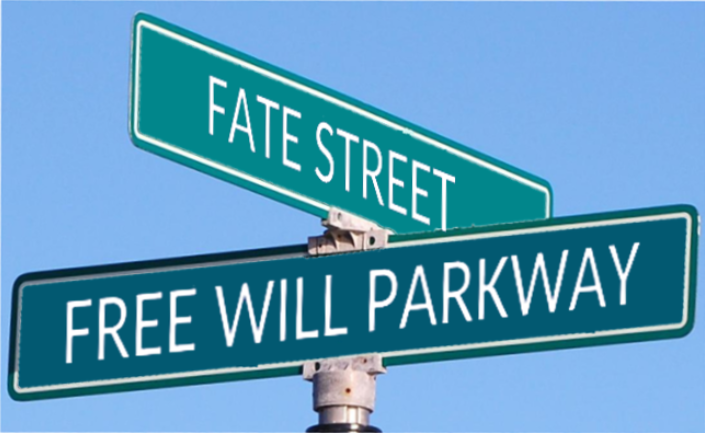
Free will vs fate

What plays the bigger role in shaping our lives (and maybe our political systems)?:
- Free will (the conscious choices we make in this lifetime), or
- Fate (being subtly, relentlessly pulled toward a preordained life path)?
Well, that might just depend on which of these things we consider to be more important—the tangibles or the intangibles.
- Tangible things that shape our lives (brain, hormones, DNA…) are generally associated with our free will.
- Intangible things (mind, karma, reincarnation, soul purpose…) are generally associated with our fate.
Generally speaking, scientists and physicians deal with the tangible, mystics and metaphysicians deal with the intangible, and psychologists stand at the crossroads to unravel “consciousness,” where the intangible (mind) meets the tangible (brain).
I suspect that the more we acknowledge and understand all of those forces associated with our fate and free will, the more meaningful our lives can be. After all, they’re almost entirely responsible for who we are, what we do, when we do it, why we do it, and how well we do it….
.
Government: society’s “alpha”
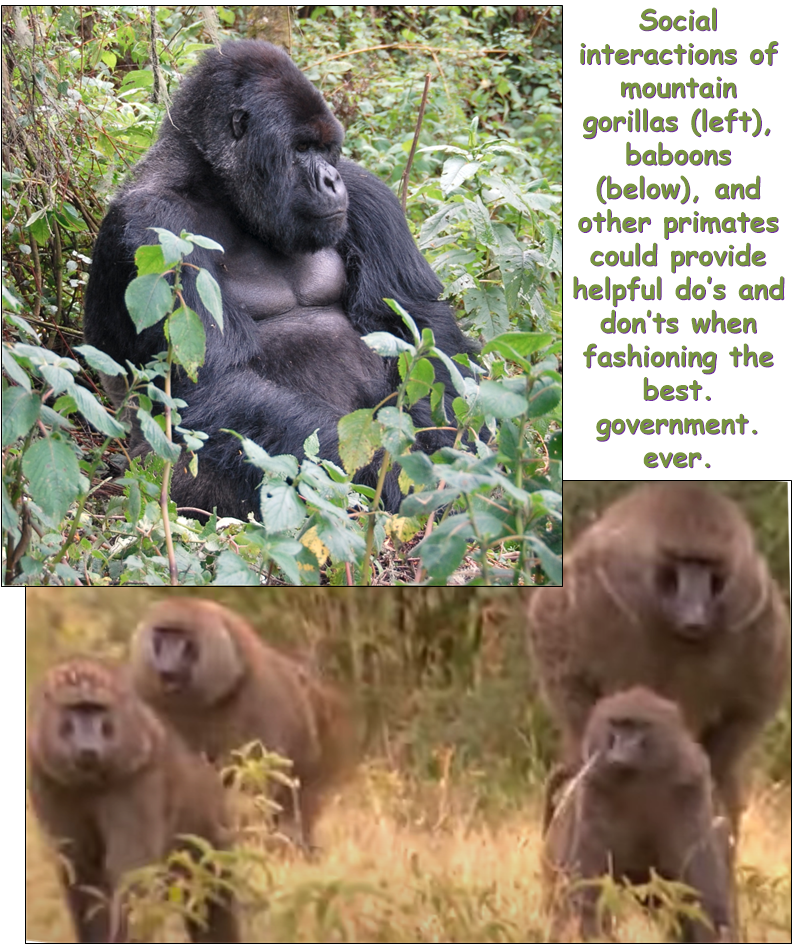
I got some great inspirations about governments from an unlikely source. Regina read Robert Sapolsky’s A Primate’s Memoir for book club, and she thought I might enjoy it. Frankly, I went a little ape over it.
It’s about how baboons and other primates are similar to us humans. Similar reasons we enjoy life and get along with each other. Similar causes of stress and suffering when dealing with each other. Similar ways we vie for leadership and partnerships in the community. Similar appreciation of good leaders and contempt for bad leaders.
Getting to know the leadership dynamics in primate communities and the causes of stress among their members might give us some clues on how to develop governments that can minimize stress in our lives and in our world.
For example:
- Some unavoidable causes of stress on Earth: Consumption and waste, dark symbiotic relationships like competition and predation, reproduction and overpopulation, difficulties of social living, and incompatibility and intolerance.
- Some solutions to minimize stress: Avoid overpopulation and overconsumption, use “clean energy,” foster freedom and fairness, meet everyone’s basic needs, and urge tolerance and compatibility.
.
More Articles from NobleSavageWorld
.
Election fraud 2012
I think this article might be “required reading” in the closing months of 2024, as the USA approaches the most important election in its history. I’m fairly convinced that finer beings intervened in the 2012 election to prevent a savage takeover of American government. If there are plans for a similar savage takeover of US government this year, I’m not sure if those finer beings will rally for a noble cause again, the way they did 12 years ago.
I know (sigh)… angels intervening in elections to protect noble humanity sounds a little crazy, but the original article tries to explain it, with lots of evidence.
(Note: After rereading that article I can safely say that most of my vehemence has subsided over the years. Meditation has helped me calm down. 🙂 )
.
Humor in politics
Some samples from a decade ago:
“There are reports that nine of the hotels being used for politicians at the Democratic National Convention have bedbugs. When asked what it’s like to have to deal with thousands of ruthless bloodsuckers, the bedbugs were like, ‘Eh, it’s OK.’” – Jimmy Fallon
“This year the theme of the Republican convention is ’50 Shades of White.’” – David Letterman
“It’s Opening Day of the U.N in New York…Mahmoud Ahmadinejad is here. He says he hates gay people and he hates Jews. Boy is he in the wrong town.” – David Letterman
“Saudi Arabia’s first female athlete will be allowed to compete while wearing a head scarf. The Saudi woman said she was thrilled about the ruling. All she needs now is a man to drive her to the Olympics.” – Conan O’Brien
.
Blown to bits in the computer age
This article philosophizes on how computer standards (bits and bytes) make global communication possible with our phones and computers.
.
Standards, the key to peace
This article goes into more detail about telecommunication standards, then looks at far-reaching political and religious standards that could maximize peace and prosperity in the world.
.
Final thoughts before election 2024
At critical moments in history, certain key countries succumb to mass hysteria. Manyi people go rabid with hate and intolerance. Things become chaotic—and, well… crazy—and no amount of reason can shift the tides. It’s a precursor to cataclysmic events that rattle the world—events like revolution, government overthrow, and war. I’m posting this article on both websites. It’ll be removed from MacyAfterlife after the election, but it’ll stay in the NobleSavage archives.
Tuesday’s presidential election here in the States is really a battle between two different forms of government—democracy and authoritarianism (a.k.a “dictatorship”):
- Capitalist democracy has forged the USA over the past two-and-a-half centuries, based on the idea that citizens are willing and able to shape the government to some degree by voting for their leaders. The Democrats (“liberals”) want to preserve that democracy, with Kamala Harris as their president.
- Authoritarian government, or “dictatorship,” is led by people who believe they know what’s best for the country, and the citizens simply have to trust that they’re right. Voting is either abolished, ignored, or rigged to sustain the leadership. The Republicans (“conservatives”) want to establish a government with “Unitary Executive Theory” (a polite name for dictatorship). Donald Trump represents the conservative view.
And there are pros and cons with either choice:
#1 Pros and Cons
Here’s the main advantage and the main disadvantage of each type of government.
There are other pros and cons, but to keep things simple, these 4 items are what I consider the most basic:
- Democratic advantage: There’s an on-going effort among government decision-makers to sustain a balance between freedom and fairness in society.
- Democratic disadvantage: There’s endless debate among political parties and personalities while decisions are being made, resulting in policies that are often weak and compromised.
- Authoritarian advantage: Policies and programs can be established quickly, since there’s no debate.
- Authoritarian disadvantage: The entire society, its economy, and its international policies are determined by a relatively few individuals with inherent human flaws, making government unpredictable at best, and potentially very dangerous, depending on the mental stability, character and personalities of the leaders.
Conditions that Make ANY Government Good or Bad
Any government can be “good” or “bad,” whether it’s democratic, authoritarian, or whatever, and it all depends on how noble or how savage the leaders are in their decision-making. These terms—noble and savage—are not capricious labels put on human behavior, but are meant to represent cosmic principles that have been the same everywhere, always… based on evidence I’ve gathered over the past half-century of research.
Noble motivations foster peace and order. They include love, honesty, tolerance, and empathy.
Savage motivations lead to conflict and chaos. They include hate, lies, intolerance, and self-gratification.
Noble Government
Governments that operate mostly on love, honesty, tolerance, and empathy are the best governments. Period.* Noble motivations like those foster peace and order in society (as well as in the citizens who adopt them for personal living). A noble government includes viable programs for health, education, and welfare, as well as ensuring a good infrastructure for safe, clean transportation and communication, while nurturing a healthy environment.
*… even if government has to resort to savage behavior in times of crisis. This is Planet Earth, after all, where environmental, social, and international forces are often in crisis. Society is like the human body, which has defense mechanisms like white blood cells that are always on call to defend the body against invasive viruses and bacteria, but once the crisis over, the defense system retreats back to base and remains on call.
Savage Government
Governments that operate on hate, lies, intolerance, and self-gratification are the worst governments. Savage motivations like those always lead to conflict and chaos in society (and in the minds and lives of citizens who succumb to that savage way of thinking). When savage motivations become the operational standard of any society, then conflict and chaos become a way of life.
# # #


 Noble Savage World
Thank you Mark.
This one, and the other ones, are a very nice compendium to have for ongoing study. You have created and produced some greatly informative content over the years.
Much appreciated, John. 🙂
Still lots of loose ends to tie up on this website, but it keeps me busy….
Mark