
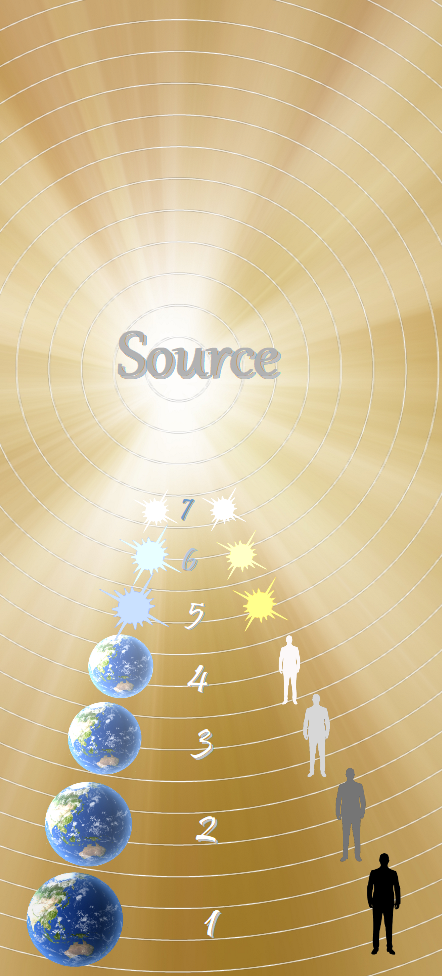
This article lays out a general scenario for healing the Earth. It’s a sort of travel planner for mankind’s journey toward a predestined future of peace and happiness.
Now that we’ve embarked on the journey, here are a few things that we’ll be recording in our trip log.
First, an overview: While humanity navigates through arduous twists and turns, there’s also a more intimate, peaceful, and personal journey underway, as we fellow travelers integrate our fleeting lives on Earth with the divine, eternal spark that shines deep within, at the center of everything.
- Main stop: The highlight of the journey is an unprecedented event that brings the world together… coupled with a spreading spiritual awareness that “we are all one.”
- Intermediate stops: Meanwhile, lots of other fascinating things are in the travel plan, as we explore the tangled ways of Earth and the elegant ways of spirit.
- Last stop: It’s rumored that a major storm front is developing back home. While that news nags at us throughout the journey, we know deep-down that everything’s going to be okay… as long as we “understand, acknowledge, devise, and act.”
When enough of us understand and acknowledge the idea below the picture (above right), momentous things will happen in our world. This article takes a glance at some of those things… and how to get there.
So, here’s the travel plan….
The Earth journey: Establishing a popular world government —— Northern Europe does it right —— Planetary housekeeping needs a feminine touch —— Balancing freedom and fairness —— Providing basic income —— Keeping population at safe levels —— Managing products and resources —— Clean energy
The cosmic journey: Relationships on Earth and in spirit are worlds apart —— Conversations on Earth and in spirit are worlds apart —— Why do people suffer? —— Out of suffering —— Money money money (artificial life-energy) —— Peace and joy in a brutal world —— Physical life and spiritual life —— End time
.
Two Articles from NobleSavageWorld
Establishing a popular world government
Note: This section was updated in December 2024 to account for a big change in world affairs.
World government is the main stop along the journey toward planetary healing.
For thousands of years, people and their tribes and their nations have struggled to get along, and a decent world government could usher in a new era of peace. Here are two possible ways that it could happen:
- Democratically (in which big decisions are made by the citizens through their elected representatives) or
- Authoritarianly (in which big decisions are made by a small team of government leaders).
The democratic way would be safer but more complicated. The authoritarian way would be simpler but more dangerous.
In a democratic manner: A sort of United Nations “World Unity Coalition” could be formed. All nations would be invited to join the coalition. Joining just means agreeing to be an active member for (say) 10 years. Member nations would agree that planetary interests are more important than national, religious, or business interests. (Any nation that prefers its autonomy is free to decline the invitation.) So, the coalition would start out as a voluntary alliance of nations who agree that a united planet takes precedence over contentious, struggling nations.
A new form of government would be conceived that finds a comfortable balance between freedom and fairness. That would become the framework of the world government, and each member country would pattern its own government after it. Ideas could be gleaned from Northern Europe (see below).
The members would pass resolutions to try to keep the planet flourishing in peace and prosperity. The resolutions would advise on issues like population, immigration, resource consumption, environmental protection, clean energy, equity, and justice. It would probably include a basic income program (see below),
Specific programs (defense, cybersecurity, population, resource use…) would evolve to meet the challenges of preserving peace in this evolving, noble-savage world. For example, member nations might all agree on a “no weapons” clause in each member nation, while the coalition government (or evolving world government) would be well prepared to defend itself and its members against “rogue, non-member states.”
This fledgling world government would be guided by a hope and dream: The member countries would all begin to flourish, and other countries would be encouraged to join.
In an authoritarian manner. Starting next month (January 2025), the three most powerful countries in the world—China, USA, and Russia—will be led by authoritarian governments.
Peaceful scenario: The three governments begin to negotiate and compromise with each other on policies to unify and heal the world. They pool their talents (American innovation and diversity; Chinese population control and infrastructure, Russian arts and literature and camaraderie…). Then, while planning the future, the three powers make the most of the United Nations (whether working through the UN or hiring the UN in an advisory capacity) with its vast knowledge of the state of the world. Most people and countries throughout the world grow to accept the three new leaders and fall in line with their plans.
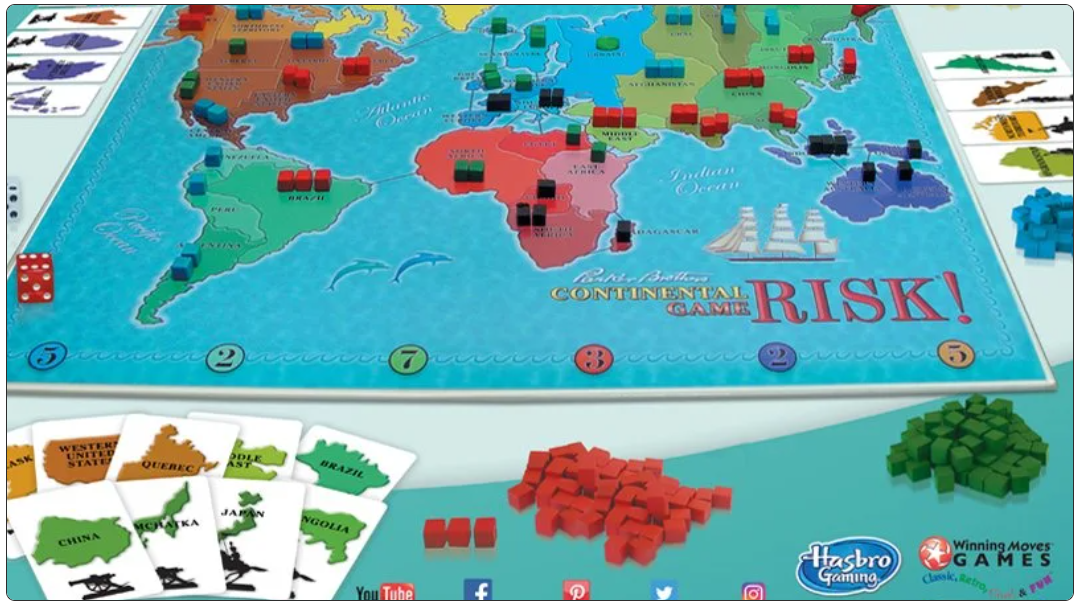
Explosive scenario: International politics becomes a game of Risk, in which the three players fight each other for world domination… winner take all. In a world of nuclear weapons, that scenario would probably drag humanity to a smoldering end game.
(The picture: If world affairs were a Risk! game played by all nations, then today we’re in the final stage of that game. China, America, and Russia hold almost all of the cards and game pieces… what political experts call “spheres of influence.” What they do now will decide the fate of the world… end the game in a three-way tie, or continue to a devastating, winner-take-all conclusion.)
.
Northern Europe does it right

Nations today could get tips on good government from the “social democracies” of northern Europe. Every year the World Population Review makes a list of the happiest countries in the world, and Scandinavian countries are usually at or near the top of the list. Those countries strive to strike a balance between freedom and fairness for their citizens (see below).
.
Ideas Gleaned from NobleSavageWorld
The ideas below were gleaned from many old articles from these NobleSavageWorld collections: Transforming Economics, Fixing America, and Gender Dramas. Those collections are being removed from the website, but the separate articles will stay buried deep in the archives… where they belong. 🙂
Planetary Housekeeping Needs a Feminine Touch
In recent centuries, the feminine role in leadership positions has been greatly undervalued. While women have historically felt pressured to stay in the background of management and world affairs, and while they’ve made big strides toward equality here in the States and around the world this century, I think the landmark research of Carol Gilligan that was published late last century (1982) digs beneath all of the complicated social and political changes to reveal some key gender differences that are probably woven into our hormones, DNA, and general biology. Those basic differences suggest (to me, at least) that the planet would be better off if women (or at least people with feminine qualities like sensitivity and relationship) held most leadership positions throughout world society, and if men (or people with masculine qualities like aggressiveness and strict rulebooks) only played supporting roles. Male qualities would be especially helpful in times of crisis… or when things need to be fixed. 🙂
Here are some of those gender differences:
Children’s games. Boys tend to play competitive games outdoors in large groups. The games are often long-lasting and involve a lot of skill. Disputes break out fairly often, but boys seem to enjoy resolving conflicts as much as playing the game. Boys are preoccupied by game rules, referring to them frequently to work out disputes. While playing, boys learn competitiveness, independence, and organizational skills that will be helpful later in life in coordinating the activities of large, diverse groups. Girls like to play indoors, usually in small, intimate groups. The games are less competitive, more cooperative, and when disputes break out the girls usually end the game rather than threaten the relationships. Girls are more flexible than boys; they are more likely to bend the rules and adopt any changes that will result in greater fairness and less pain all around. Girls learn to cooperate smoothly while nurturing and preserving interpersonal relationships. They become open-minded.
Law and ethics. Women consider many variables when deciding what’s “right,” so the feminine approach can be more comprehensive and painstaking as women search for the decision that will cause the least conflict and pain. Women want to nurture healthy relationships, even if it requires more time, more creativity, and a bending of rules to come up with the “right” solution. Men make hastier, more rational decisions. They eliminate many variables by creating legal and ethical boundaries and rules. To make the “right” decision they simply consult the rulebooks. They want quick, neat justice… even if it sometimes causes pain to individuals and puts a strain on relationships.
Communication. Girls share their feelings in detail, analyzing relationships during long phone conversations or in hushed, excited give-and-take. Boys talk about cars, girls, sports, studies… virtually anything but their feelings. Boys and girls generally agree on one thing, though: the opposite sex seems fascinated by trivial things.
Interpersonal fears. Men and women fear different things about social situations. Coming together intimidates men, while moving apart intimidates women. Women fear a sense of separation and isolation, along with being held in suspicion or being rejected by others for being too successful and competitive. Men fear feeling entrapped or betrayed, humiliated by deceit, and smothered in a clingy relationship.
—Adapted from In a Different Voice, by Carol Gilligan
Granted, the world has changed a lot since that 1982 study. The Internet is filled with exceptions to those gender differences. There are boys and men who have more feminine qualities such as sensitivity and being in touch with their feelings. There are girls and women who foster masculine qualities like aggressiveness—becoming soldiers on the front lines of battle, for example. There are girls who viciously assault other girls on social media, sometimes to the point of ruining their young lives.
Exceptions and bad behavior aside, basic feminine qualities are more aligned with kindness and healing relationships. I think those basic gender differences provide an important anchor for this stop along the journey to planetary healing, in which feminine qualities would be better suited at the helm.
.
Balancing freedom and fairness
The World Happiness Report (mentioned earlier) analyzes six factors every year to gauge each country’s happiness:
- GDP per capita,
- social support (as measured by having someone to count on in times of trouble),
- healthy years of life expectancy,
- perceived freedom to make life decisions,
- generosity (as measured by recent donations, adjusted for differences in income), and
- trust (as measured by a perceived absence of corruption in government and business).
Half of those items (#2, #4, and #5) relate directly to a country’s freedom and fairness.
Social democracy and democratic socialism are probably the most successful political systems today that try to sustain a good balance between freedom and fairness… and they’re most predominant in northern Europe—Finland, Denmark, Norway, Sweden….
.
Providing basic income
Basic income is a government program that gives every adult citizen* a monthly stipend to cover their basic needs. Social programs like basic income are typically paid from the money the government earns from taxes.
*Giving basic income payments only to adults would encourage people to have smaller families (fewer mouths to feed). And giving payments only to citizens would discourage non-citizens from flooding into the country.
The amount of money paid to each adult citizen would be appropriate to the economic conditions of his or her country, to ensure everyone’s basic needs are met. It might range from $2 a month to $1,000 a month or more, depending on the current standard of living.
Basic income could help stabilize any country that has a healthy economy.*
*I think of a “healthy economy” as a condition where the product needs of the population don’t exceed the resources available to meet those needs. If resources are scarce—if there are too many people (overpopulation), or if the people use too many products (overconsumption) so that they stress the environment—then a basic income program would be more challenging. In today’s world of diminishing resources, a country’s fertility rate would probably have to be 2 or lower (1 or 2 children born per adult woman) to support a basic income program comfortably.
In rich countries like the USA, where there’s a huge gap between the very rich and the very poor, a basic income program would most logically (and fairly) be supported with a wealth tax. That would 1) reduce the suffering of society’s least fortunate and 2) narrow the gap between rich and poor.
In a nutshell, basic income would be like a medicine for any society that struggles with poverty and homelessness. And it could be implemented with no serious side-effects; each country would continue to operate in all of its familiar ways… only now there would be a safety net to protect the least fortunate.
.
Keeping population at safe levels

Comprehensive research from Australia proves one thing about human population: There’s huge debate among scientists over how many people our planet Earth can comfortably support. Estimates range from a half-billion people to more than a trillion. There are just too many variables to consider before making a conclusive argument about the ideal limits of population—how many resources are available, what kinds of resources, how many products does each person consume, how much environmental impact is acceptable?…
Unfortunately, we can’t do a comparative study with other planets like Earth—inhabited by intelligent life. If there are such planets, we don’t know any experts who are familiar with them*….
*Or do we? There are people who claim to be in touch with extraterrestrials… and some of those ETs, called “Essassanis,” have said that an Earth-size world typically has a population of about 50 million lead inhabitants, or stewards, who share their world with the diversity of plants and animals that flourish in their worlds. The essassanis say their own world maintains a steady population of about 250 million.
Me? I lean very heavily toward a small population on Earth as a best-case scenario—no more than a billion people. Today there are more than 8 billion of us.
.
Managing products and resources
For any family or nation, or for humanity at large, the economic vitality of the group is always determined, first and foremost, by what the group needs in relation to what resources are available outside the group to satisfy those needs. That can be illustrated in a simple formula:
V ≡ R : N
It just means the group’s vitality (V) is determined by (or equivalent to) the resources (R) available to satisfy the needs (N) of the group.
What makes the formula work is looking at a social system as a living system: A family (or a nation or humanity at large) consists only of people and products (the way the human body consists of cells and molecules). Everything else on the family property (or within the borders of a nation) is simply part of the environment, or global ecosystem, and resources are part of the environment.
So, the needs of the group are equal to the needs of the people and products in the group… and resources have to be available from the environment to satisfy those needs. All very simple and straightforward.
Then things get a little complicated. We’d have to come up with ways to…
…Monitor population, products, and resources (census and inventory, for example),
…Distinguish products from resources (mushrooms and meat can be farmed as products or taken from the forest as resources, for example),
…Track resources to products (how everything gets processed),
…Track recycled products back to resources (how spent products can get back into the resource field),
…Avoid duplication in product nesting (a computer is a product made up of smaller products—circuit boards, wires, plugs…—so our main concern is the computer, which is the top level of the “bill of materials.”)
Whew… just a few examples. Here’s an exhaustive analysis of this new economics based on people, products, and resources, for those interested.
For this short journey to explore planetary healing, we don’t have to get bogged down in the details.
.
Clean energy

Population, products, and resources deal mostly with material things. Next stop: energy.
In a nutshell, humanity is already well underway toward replacing filthy fossil fuels with clean energy alternatives, though there are still challenges, especially in poor countries… and in countries that are too heavily influenced by oil and coal billionaires.
.
So, those are some of the key ways to heal the planet in a practical or down-to-earth way:
- World government,
- Lessons from northern Europe,
- Advantages of feminine qualities in leadership,
- Balancing freedom and fairness,
- Providing basic income,
- Safe population levels,
- Managing products and resources, and
- Clean energy.
Next leg of the journey: Integrating spirit into the process.
.
7 Articles from MacyAfterlife
These articles from MacyAfterlife take a closer look at the spiritual forces that can help heal the planet.
Relationships on Earth and in sprit are worlds apart
This article speculates on relationships among spirits, among ETs, and among us earth-dwellers, and how the three groups relate to each other when we happen to cross paths. It’s based on some pretty good evidence.
Earth Relationships

First, we’ll look at six familiar types of people here on Earth, just a sampling or cross-section of personality or character types that help make the points of this article:
- Guiding lights on Earth are honest, wise, kind, and trustworthy people. They only want to help and support those around them. Sensitive people often feel safe and revitalized in their presence.
- Friends are well-meaning people whom we get along with. We generally trust them despite their occasional mistakes that cause hurt feelings, which they later regret.
- Jokesters enjoy dichotomy and practical jokes at other people’s expense. They might be fun to be with, but it’s hard to really trust them because we’re not sure what to expect.
- Hooligans are a rowdy bunch who cause troubles for others.
- Bullies hurt and intimidate people.
- Scoundrels are mean, deceptive, and dangerous.
Over the years I’ve come to believe that the cosmos is populated almost entirely by the first two character-types—guiding lights and friends—and Earth is kind of a special place, where living things just don’t get along with each other a lot of the time.
Let’s see if the evidence supports the notion that guiding lights and friends are the cosmic standard.

But first, as a natural segue from Earth relationships to spirit-world relationships, let’s see why Jesus couldn’t live a perfect life on Earth. He apparently came to rowdy Earth from the finest realms of spirit with a built-in conscious connection to the source. With that conscious God-connection He could espouse ageless wisdom and perform miracles even as a child (though his childhood miracles were impulsive, sometimes playful, sometimes rash, as might be expected of a human child).* As He matured, His wisdom and miracles became more refined and legendary, and He became a guiding light for humanity, reverently known as “The Christ.”
*Historical records (Gospel of Thomas) note that the child Jesus could form little birds out of clay, give them life, and let them fly away. He didn’t suffer bullies and jokesters, making one ornery neighbor boy wither away and die in front of him, and making an abusive teacher fall to the floor dead. His parents, Joseph and Mary, were pressured by their neighbors to do something about their boy!
If those accounts are true (and I suspect they are, though they’re often swept under the prayer rug), then it might explain why we humans generally feel isolated or removed from the source (or God). Evidence from India suggests that we humans aren’t allowed to have conscious contact with the source (or Brahman) the way Jesus did, until we’ve matured and purified ourselves of the rowdy compulsions that we all grow up with on Planet Earth. For a typical, temperamental, hormonal human, sudden conscious contact with the source can cause a psychotic break, even death. What does all that mean? Well, let’s take a look….
Spirit Relationships

Spirit relationships are simpler than Earth relationships, but at the same time more elaborate. Here’s how things apparently work at levels 3 through 7 of the cosmos—that vast domain of refined spirits.
Simple: Individuals, worlds, and universes all consist essentially of life-energy emitted by the source, and each entity has a unique vibration. Spirits come together naturally in communities and relationships when they vibrate in harmony with each other. That results in friendships, in the finest sense of the word. Resonance is the bonding force of life throughout most of the cosmos.
Elaborate: Countless universes and dimensions intersect with each other, so there are lots of diverse relationships going on all the time. Spirits from finer realms (closer to the source) are friends with each other, and they’re guiding lights when they encounter spirits in denser realms (farther from the source). Everything in the cosmos has many aspects of itself existing at the same time. There’s always an outermost aspect (in our case, a dense human body). Then, lots of subtler aspects become more refined and purified as they extend in-beyond toward the source. (“In-beyond” means they’re all superimposed over each other, existing in finer and finer dimensions.) So, while we’re experiencing a lifetime on Earth, our various spirit aspects are experiencing lives in various spirit worlds, as the diagram suggests. In almost every realm at every level we are a friend among friends, and in some realms we’re also a guiding light. At the very center of it all, we’re the perfect source. All of us, without exception, are one.
Then there are the spirits of a darker nature.
When we humans feel things like love, inspiration, and good-will, our consciousness is connected to that flourishing ocean of cosmic consciousness (levels 3 through 7). We are friends of the cosmos, and we share in the bounty.

But when we feel things like hatred, frustration, intolerance, deception and guilt—feelings that are not in harmony with the cosmos—then those thoughtforms get stuck around the Earth in a sort of shadow world, since there’s nowhere else for them to go. There’s a lot of unpleasant mental interplay between Earth and its shadow.
ET Relationships

Many species of ETs flourish in our galaxy, according to many experts. Most of them manage their worlds in peace, prosperity, and good will. They are cultures populated by friends and guiding lights, and many of them employ advanced spacecraft and join peaceful, productive alliances with other civilizations of other worlds… alliances like the Ashtar Galactic Federation.
These galactic alliances have been observing (and sometimes interacting with) our world for countless centuries. They’re responsible for most of the pyramids and other megaliths scattered around the planet, which they created long ago.
Today the ETs can’t form a working relationship with Earth, simply because they don’t resonate with us. They resonate with some of us—those among us who are guiding lights and refined friends with a psychic sensitivity—and they often communicate with those good souls telepathically, providing guidance, support, and good will. Their messages often carry an underlying theme: The ETs look forward to the day when we humans can join their alliances, once we’ve become a peaceful world—a world of friends and guiding lights.
But for now, they mostly just observe our world—with our unruly mix of guiding lights, friends, jokesters, hooligans, bullies, and scoundrels—with hope and concern.
Then there are those disconcerting ETs, like the ones we call “Greys” and “Reptilians,” who get involved with abductions, human-ET crossbreeding, and cattle mutilations. Like dark spirits, troublesome ETs are those who for some reason are drawn to Earth’s spiritual shadow.
Conclusion
Spirits and ETs who interact with our world are friendly, helpful, and hopeful, as a rule. The spirits and ETs are nearly always friends and guiding lights. The only time they come across as jokesters, hooligans, bullies, or scoundrels is when they venture into Earth’s shadow and begin to resonate with our dark side.
.
Conversations on Earth and in spirit are worlds apart

For our spirit friends to contact us through our phones, radios, and computers (as our INIT group experienced late last century), certain problems have to be solved first. Let’s look at the solutions, then the challenges and the how-to’s of ITC will fall into place along the way.
- Acknowledge basic communication differences. We on Earth communicate mostly through our five senses with words, pictures, and videos. Spirits communicate silently, mind to mind, exchanging thought impulses. For ITC, they have to convert their thoughts to words and pictures we’ll understand. They’re telepathic, we’re not.
- Reawaken our psyche. Apparently we’re born telepathic, but most of us lose the skill around age 6, so either we restore the ability for ITC experiments or work with someone who’s psychically gifted. That’s because ITC contacts aren’t simply delivered from the spirit world to our world the way we make a phone call or send an email. They come through a mind connection or “contact field,” as explained in #4 below.
- Recognize an ITC aptitude. An ITC aptitude is similar to telepathy. Some people are born with a powerful psyche that can make big, imperceptible changes in their surroundings.
- Keep the contact field resonant. An ITC bridge between level 1 (Earth) and level 3 (our afterlife paradise) is called a “contact field.” It’s formed by the collective consciousness of everyone involved in the contact, on both ends of the bridge.
- Acknowledge the role of finer beings. We need protection in ITC work because of the envy, skepticism, animosity, resentment, and other negative feelings that we human researchers experience normally in our day-to-day lives. Dark thoughts make the contact field murky and unstable, allowing troubled and confused entities from Earth’s shadow to break into the bridge with unsettling messages. Finer beings provide moral support and advise us to avoid fear and envy while trying to get along with each other in our ITC pursuits.
- Accept the source as the only reality. The source is at the center of everything. The most important thing in ITC—and in life—is to acknowledge the source at the center of our being (also called God, Allah, Brahman, or the principle). It generally shines brilliantly (but invisibly) in the area around the heart. The best way I know to acknowledge the source and make conscious contact, is heart meditation, which is described elsewhere on this website.
.
Why do people suffer?
Which statement is closer to the truth?
- There’s a lot of pain and suffering in our lives and in our world.
- We spend our lifetime free of pain and suffering.
At first glance, from a lifetime of experience, the answer is obvious to us all: (1) is true and (2) is false.
But according to mystics, in the bigger metaphysical picture that extends beyond a lifetime into eternity, (2) is closer to the truth, and (1) is largely an illusion. Mystics see the truth of oneness through spiritual eyes. They see beyond the duality (Earth’s darkness vs. the “inner light”).
The Why Do People Suffer article tries to unravel human suffering to see if we can find “the truth” that all the great mystics talk about… and why, from the big picture, life on Earth with all of its suffering is mostly “an illusion.”
.
Out of suffering

The title of this article suggests a couple of things:
- Out of suffering can come peace, strength, and understanding… and
- There’s a force in the cosmos that can lift us out of suffering, or at least turn it to our advantage.
First, we look at why we suffer:
- Earthy things can make us suffer—accidents, addictions, assaults, competitors, crimes, deceptions, disasters, diseases, genetic defects, hunger, loss, parasites, poverty, poisoning, predators, war….
- Psychological things can make us suffer—fear of death, sense of separateness, wishful thinking, attachments, expectations, negative emotions.…
- Spiritual things can make us suffer—karma, meddling spirits from the shadow, our soul choices for a lifetime….
Bottom line: To live on Earth is to suffer.
There’s a simple cosmic principle that can lift us out of suffering, or at least turn it to our advantage:
Understand and acknowledge the presence of the source at the center of our being, at the center of everything. Foster conscious contact with the source, especially with meditation or contemplative prayer.
.
Money money money (artificial life-energy)

Money is an artificial life-energy that we use here on Terra to create and nourish our social systems and our lives. The real stuff—life-energy from the source—creates and nourishes everything throughout the cosmos. There are differences in the way the real stuff and the fake stuff are distributed and in the way they work:
- Life-energy is simple in its distribution. Emitted constantly and freely by the source, it belongs to everyone and everything everywhere, since we’re all part of the source.
- Money is complicated in its distribution, provided by governments and their banks here on Terra and managed according to bristly economic and political principles—democratic, autocratic, capitalistic, socialistic, communistic, Islamic….
At the same time…
- Life-energy is complicated in the way it works (there’s an understatement!)—spreading boundless vitality, love, and knowledge to everything throughout the cosmos.
- Money is simple in the way it works; it just represents the relative value of everything associated with people and their social systems.
The more effort we put into attuning ourselves to pure life-energy (through meditation, prayer, decency… ), the less we’re obsessed with Earth’s illusory dramas… such as money. And then our finer spiritual vibration becomes a homing signal to paradise after we die.
.
Peace and joy in a brutal world
This article is about how to find peace in a troubled world, simply by understanding and acknowledging our connection to the source.
.
Physical life and spiritual life

Like everything else here in this physical universe, we humans have a rich spiritual composition. Our physical body has astral and ethereal bodies nested within it, or superimposed over it.
While we live our life here at level 1, our astral bodies (subtle copies of our physical body) are living concurrent lives at levels 2, 3, and 4. Our ethereal bodies live as formless, brilliant energy beings and light beings at levels 5, 6, and 7.
Our central body (or soul or atman) is the source itself—brilliant, timeless, and eternal—which is shared by everyone and everything everywhere.
When our physical body dies, our many spirit bodies continue to flourish.
Just like a physical human, a physical planet like Earth also has spiritual copies superimposed over itself at all levels leading to the source. Most of those subtle planets are probably flourishing with life, even if the physical planet seems “lifeless.” And when a physical planet dies or is destroyed, its spiritual copies continue to flourish.
Ever since Eden was destroyed long ago (probably a Saturn-size planet between Mars and Jupiter), its spiritual bodies have continued to flourish. Earth and Eden share a common heritage (because of the Edenites marooned on Earth), so some people who die on Earth awaken in the paradise version of Eden at level 3. Other people presumably awaken in one of Earth’s own spiritual-world templates.
.
End Time
Late last century, “The Seven” finer beings told our INIT group, through a computer at our Luxembourg station:
We have often given you the real purpose of ITC contacts: Mankind at the End Time should be led back to the principle. Light and darkness shall unite and form a whole again. What people experience now is not the actual beginning of the apocalypse, but only the first symptoms.
Apparently, Earth civilization has a very long history going back many thousands of years as empires rose and fell. Through it all, living conditions got better and better in the world, but in many ways they also got worse and worse. That’s because of the noble-savage qualities of life in our world that are built into our human dispositions—love, awe, and trust resting uneasily with hate, fear, and suspicion. Eventually conditions reach crisis level, and there’s a sort of system reboot of humanity—a time of general housecleaning.
According to some miraculous prophecies, we’re apparently approaching another of these End Times, when the “light” that influences our world from finer cosmic realms is brought together with the “darkness” that comes from Earth’s spiritual shadow. Our tomes of light and games of darkness are all brought to the table to be sorted out… and emotions get stirred up.
Our friends and guiding lights in the spirit worlds apparently know an apocalypse is coming, but they’re just not exactly sure when all the big excitement will begin—Earth shifting on its axis due to polar melt, perhaps, or horrific fires and floods, or nuclear war… or whatever else is in store. Who really knows when (or even if) such an event will happen. Time is nebulous.
If another End Time is approaching (and I suspect it is), then the best way to get through it is simply to understand and acknowledge our spiritual heritage. Understand and acknowledge that we all have the perfect source at the center of our being. Take time regularly to foster conscious contact with the source, especially through meditation, prayer, and decent thoughts and actions. That way, we move through Earth’s mounting dramas peacefully and spiritually unscathed.
Making a conscious effort to be decent can help, but it has limitations, since we’re always in a conscious battle with our biology (ego, hormones…), which sometimes urge us to be not-so-decent.
However, if we pray and meditate regularly to foster conscious contact with the source, those bristly biological forces are gradually put to rest.
.
Hopefully, these ideas provide helpful tips on how to heal our world… and ourselves.
# # #


 Noble Savage World
Wow! The article is amazingly comprehensive and wonderful. It’s great! 🩵💛💙
Ah… a comment from my fan club! Thank you, dear wife 🙂 Love you, M
Dear A Vance,
I have one of those rare copies of “Last Chance for Peace”. You gave me this copy in March, 2007, with a nice note on the title page. It is your densest writing, and in it you do write a good bit about spiritual values and the importance of such in our world.
The book is prescient.
And from your words above….”While many world problems (population and environment, for example) do require worldly solutions, I’m now certain that most of Earth’s troubles will only be fixed with spiritual or “cosmic” solutions, which bubble up from the finer spirit deep within us. It’s a personal journey, taken by many, that will heal the planet. Lots of people today are on that spiritual quest, but not enough. Unless more of us join, far more powerful spiritual forces will intervene and support us through an apocalyptic time.”
If your middle initial is a D, then your pen name might be ADVance.
Thanks John! Another ‘blast from the past.’ 🙂
I self-published that book in 1985, three years before your surgical skill saved me from my own “end time,” and your studies and practices in eastern spirituality started me moving along the light path. I’m eternally grateful.
Mark
ADVance = advance!
Yes, onward and upward…….. 🙂